Wednesday, December 9, 2020

 Stuck belly up on a coral reef: a sea urchin’s nightmare becomes reality 

by post-doc Noelle Lucey

Published this week in Frontiers in Marine Science:  

click here to see the article


Oceans are warming, becoming more acidic and devoid of oxygen. We wanted to know how hot, hypoxic and acidic one of the most exposed, well-flushed, active coral reefs in Bocas del Toro, Panama got last year. Temperatures reached 32.7°C (or 90.9°F), which would make most of us start sweating or look for air conditioning. When temperatures were at their highest, both oxygen and pH (a measure of acidity), were at their lowest. This was particularly evident at night, when pH and DO plunged to startlingly low levels. While severe, at least on the reef, these conditions were fleeting, not lasting more than four hours at a time. This relationship between temperature, oxygen, and pH wasn’t just found on the reef, but throughout the larger surrounding area. 


The reef at Hospital Point where we conducted
the study


But do the severe conditions that occur on the reef, all at the same time, have any negative impact on animals that live in them- even in short 2-hour doses? The well-exposed coral reef we measured the extreme conditions on is also one of the best places to collect the sea urchin, Echinometra lucunter. On first glance this is just a black, spiny sea urchin that is far to common to even consider putting your foot down on the reef. If the surf isn’t too rough, you can notice that they are hiding in every crevice and reef crack, happily getting pounded by the waves. When the sunlight hits them perfectly, they shimmer with bright purple and red colors.


We pried these sea urchins out of their hiding places with teaspoons and brought them the Bocas Research Station to expose them in the laboratory to the same severe hot, hypoxic and acidic conditions they felt on the reef for two hours. Once they were exposed to these different stressors, both singularly and together, we flipped them upside down. Normally, when a sea urchin is flipped on its back uses its spines and tube feet to immediately turn itself back over. It’s a sign of healthy, happy individual. If they don’t right themselves quickly, they might get beaten up by the surf or eaten by reef fish, or both. Finding their hiding spot and wedging into the reef will help them stay alive. 


Eileen sorts animals and puts the "babies" back
into the water (because we only did
experiments with adults)


It was much harder for urchins to right themselves after being in deoxygenated water for two hours. While they lay upside-down, some with limp tube feet, most survived and were returned to the reef. We repeated this experiment a second time, after keeping them in the lab for a week at different pH, and again found no negative effect of low pH. However, urchins were incapable of finding their footing and flipping right-side up after low oxygen conditions, as well as hot temperatures.  


Surprisingly, it appears that even the tropical coastal environments that get plenty of wave action experience severe conditions, and these are pushing the limits of marine organisms that live in them. The lack of oxygen and high temperatures are instant bad news for reef animals. Not to mention, these severe conditions are occurring more frequently and for longer periods of time, upping the stress levels experienced by important reef organisms like sea urchins. 


This work would not have been possible without the support and funding from the Smithsonian Tropical Research Institution, the Bocas del Toro Research Station and MarineGEO.


Lucey, N., Haskett, E., Collin R. 2020. “Multi-stressor extremes found on a tropical coral reef impair performance.” Frontiers in Marine Science. DOI: 10.3389/fmars.2020.588764


Noelle Lucey, Antonia Hergwig (a STRI volunteer), and
Eileen Haskett head back to the Bocas Station after
collecting animals


Tuesday, October 6, 2020

The identity of this unusual sea creature was a mystery to biologists for 30 years.

The key to figuring it out was to think globally, not locally.

Mystery has surrounded these tiny animals since they were first discovered in the Gulf Stream.  Easily identified as sea star larvae (i.e., babies) they are some of the most abundant animals in certain plankton samples. Not only are samples “crawling” with them, but they show evidence of cloning themselves, something that was previously not known to occur in sea star larvae.  Using DNA sequences scientists have searched for 30 years for a match between these distinctive larvae and adult sea stars from the Gulf of Mexico and the Caribbean.


We collected some of the mystery larvae as part of project to describe and identify the larvae living in Panamanian waters. Like the prince with Cinderella’s slipper, we initially could not find a match to our DNA sequences either.  Using the Barcode of Life Database, we discovered a match to an unpublished sequence from the Indo-Pacific. No information other than the name of the scientist who generated the sequence was public, Gustav Paulay. Luckily (in this case anyway), the community of biologists working on marine invertebrates is small and I knew Gustav. After comparing the sequences, we agreed that the sequences from the Caribbean larvae match the sequences of a rarely seen sea star from the Indo-West Pacific, Valvaster striatus


This sea star appears to range across almost all of the Pacific, but it lives deeply hidden inside coral reefs, making them difficult to find without literally taking the reef apart.  


Adults have never been reported in the Caribbean, but they must presumably be lurking here, out of sight, shedding eggs and sperm into the water column to generate these famous larvae…. Or… maybe the larvae are cloning themselves, maintaining dense populations without the need for adults.


Only time (and more research) will tell.


Read our original publication at:  https://www.journals.uchicago.edu/doi/10.1086/710796


Collin, R., D. E. Venera-PontónG. Paulay, and M. J. Boyle.  2020.  World Travelers: DNA Barcoding Unmasks the Origin of Cloning Asteroid Larvae from the Caribbean.  Biological Bulletin.  doi/10.1086/710796


Sunday, November 2, 2014

Do Slipper Snails Really Brood in the Mantle Cavity

Slipper snails brood their offspring.  They produce eggs enclosed in transparent capsules and they keep these covered by the shell.  The scientific literature is full of statements that they "brood in the mantle cavity".  This is not accurate.

What is the mantle cavity?
The mantle is characteristic of molluscs and is basically a skirt of tissue formed by the dorsal body wall  that covers the visceral mass.  In squid it is the part that is used as squid rings.  In clams and snails it is the tissue that underlies the shell.
Head-on view of a Crepidula

The mantle cavity is defined as the space enclosed by the mantle and  includes the gills, anus, osphradium and gonopores.  In slipper snails this space is large, to contain the extensive gills needed for filter feeding.  It extends from the front margin of the shell, over the head, and gradually tapers all the way to the posterior end.

Slipper snails do not brood their egg capsules in this space.

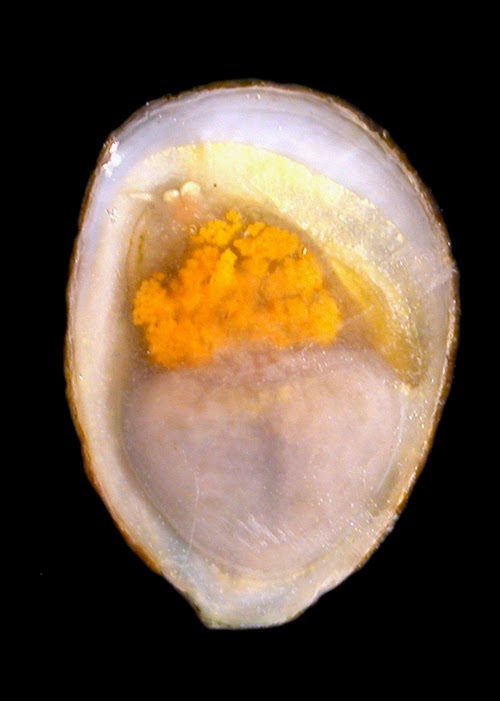
Crepidula atrasolea brooding.  The eggs are orange and
can be seen through the plastic the snail has attached to


Where do slipper snails keep their eggs?
In the CollinLab we keep slipper snails in plastic cups.  In this way we can see when they produce eggs and we can collect the embryos or larvae at the age or stage we need.  Looking a the snails in this way it is very clear that the egg capsules are deposited under the snail, not above the head in the mantle cavity, but below the head.  The mother attaches the stalks of the capsules to the substrate beneath her neck.  As far as we know there is not formal anatomical name for this space.  In publications we say that slipper snails brood the egg capsules "between the substrate, the neck and the propodium".

Head-on view showing the location of the eggs relative to the mantle cavity

Lateral view showing the eggs relative to the mantle cavity


Tuesday, February 11, 2014

Why snails sometimes wear nail polish and corals sometimes wear tampons

The second floor of the Naos Laboratories is packed to the ceiling with high-tech DNA sequencing equipment: precision incubators, heatblocks, PCR machines for replicating DNA molecules, robots for processing samples and DNA sequencing machines.

It’s a different story up on the third floor. You’d be surprised at what things ecologists bring in from home to use in the lab.  Here are a few of the items we use in the CollinLab:

Nail polish is great for marking individual snails.  We want to follow snails in the intertidal to see if they return every day to the same pool or crevice.  Now that you can get so many colors it's perfect to just dab a bit of polish on each snail. 

20 years ago it was all shades of red and pink, but now the snails can really shine. 
…. and yes, certain snails look better in certain colors.

A yogurt maker has been used in the lab to test the tolerance of Nerita egg capsules to high temperatures.  Aquarium heaters have a built-in shut-off before they reach temperatures experienced in tropical tide pools. The yogurt maker hits the exact temperature.


Custard dishes.  We buy these by the case to use for larval rearing experiments.  They fit perfectly under the microscope.


It's not just the CollinLab that gets creative.  In fact, we are rather tame in our choices compared to some famous marine biology researchers.  My favorite examples include:

In a flamboyant landmark study Mimi Koehl and Tom Powell threw pounds of glitter, poppy seeds and snapdragon seeds off the rocks of the Washington coast.  They wanted to understand how waves disperse small particles away from the intertidal. The glitter and seeds were used to model different kinds of marine invertebrate eggs (some eggs are buoyant and some sink).  So they released thousands of these "artificial" eggs at one time and used fluorescein to label the sea water.  A team of students and helpers scooped up samples of water along the coast to track the movement of the different particles to see if they all traveled in the same way with the water. 


In a another important but quirky study, researchers working at the Bocas del Toro Research Station tied tampons to corals.  They wanted to understand the causative agents of coral disease.  Davey Kline and Steve Vollmer extracted different microbes from infected areas of coral tissues.  To find out which of these cause the disease, which are benign, and which are secondary infections that do not transmit the disease, they needed to expose corals to the different isolated microbes.  They searched the small town of Bocas del Toro for materials that could be used to absorb the different solutions and tied to the corals to expose an area of health tissue to the potential pathogens.  Tampons turned out to be perfect!  The experiment was a success and was published in Nature-Scientific Reports.


Let us know if you have used art, kitchen, or personal supplies for unusual scientific purposes.

Thursday, November 14, 2013

Snail Porno - How Slipper Snails Do IT


As a side project in the lab we have been making snail porn (here for full YouTube video).  Trying to get photos or videos of our snails in the act, doing the deed, getting it on... or as we say in lab, copulating or mating.

The last post described how to tell the sex of slipper snails.  Just like lots of animals males have a penis and females have an opening that receives the penis and the sperm.  But, something we would like to know is how exactly does this transfer happen?

The snails are shy and seeing what's going on is easier said than done.  


You can see the penis from the malCrepidula fornicata extending under the shell of the female he is stacked on.


The common idea that slipper snails have to be stacked one on top of the other to mate is not always true.This small Crepidula onyx is extending his penis across the substrate to the female. 


From observations of snails in cups like these we know that mating can last for hours.  Snails are slow, but what is going on under there for all that time?  Recently Matt Starr, a student in the lab, was lucky enough to get this footage of mating in a pair of snails that had been detached from the substrate.
Here the male is just exploring, prior to copulation.

To most people it probably seems that as long as mating happens and successfully produces offspring it's not really important exactly how.  But the details of copulation can shed light on some important questions in evolutionary biology and behavioral research.  For example:  Can females control who they mate with? Why do females mate more often than necessary to fertilize their eggs?
If they mate with more than one male, can females manipulate whose sperm they use to fertilize their eggs? 

Copulation!

We already knew, from anatomy that sperm is passed to the female in an open groove that runs to the end of the penis.  Unfortunately we can't see the sperm moving in the videos.

But we can see that there is a lot of activity on the part of both the male and female.  We can see is that the long thin papilla at the end of the penis inserts into the female genital papilla.  That's not so surprising, but makes us wonder what happens in the many species that lack both the female genital papilla as well as thin extension of the penis.

So far Crepidula incurva is the only species for which we've obtained video.  We hope to find out how copulation differs across species with different penis morphologies and why mating takes so long.  In some animals the male uses his penis to displace sperm that were deposited by previous males, could this be what's taking so long when Crepidula mate?