Showing posts with label crepidula. Show all posts

Sunday, November 2, 2014

Do Slipper Snails Really Brood in the Mantle Cavity

Slipper snails brood their offspring.  They produce eggs enclosed in transparent capsules and they keep these covered by the shell.  The scientific literature is full of statements that they "brood in the mantle cavity".  This is not accurate.

What is the mantle cavity?
The mantle is characteristic of molluscs and is basically a skirt of tissue formed by the dorsal body wall  that covers the visceral mass.  In squid it is the part that is used as squid rings.  In clams and snails it is the tissue that underlies the shell.
Head-on view of a Crepidula

The mantle cavity is defined as the space enclosed by the mantle and  includes the gills, anus, osphradium and gonopores.  In slipper snails this space is large, to contain the extensive gills needed for filter feeding.  It extends from the front margin of the shell, over the head, and gradually tapers all the way to the posterior end.

Slipper snails do not brood their egg capsules in this space.
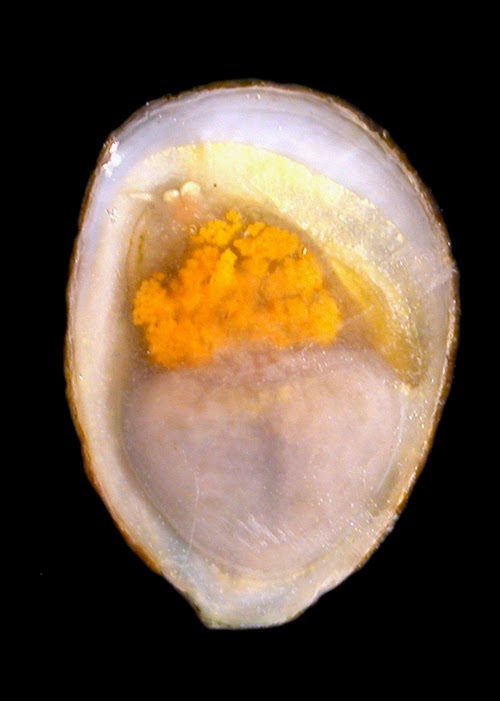
Crepidula atrasolea brooding.  The eggs are orange and
can be seen through the plastic the snail has attached to


Where do slipper snails keep their eggs?
In the CollinLab we keep slipper snails in plastic cups.  In this way we can see when they produce eggs and we can collect the embryos or larvae at the age or stage we need.  Looking a the snails in this way it is very clear that the egg capsules are deposited under the snail, not above the head in the mantle cavity, but below the head.  The mother attaches the stalks of the capsules to the substrate beneath her neck.  As far as we know there is not formal anatomical name for this space.  In publications we say that slipper snails brood the egg capsules "between the substrate, the neck and the propodium".

Head-on view showing the location of the eggs relative to the mantle cavity

Lateral view showing the eggs relative to the mantle cavity


Wednesday, August 7, 2013

How to Tell the Sex of a Slipper Snail .... And Why You'd Want to....

Quite a few people who ask about our research are surprised that snails can be males or females. They have probably never thought about invertebrates having genders. Some snails, like garden snails, are simultaneous hermaphrodites --- both males and females at the same time.  What's even more surprising to people is that some snails change sex.  In fact quite a lot of the research in our lab is focused on understanding when and why slipper snails change sex.

To conduct experiments on sex change, we need to know how to tell the difference between males and females, and how to identify individuals that are transitioning.

So, how can you tell the difference between a male and a female?  First of all... Not this way:
Mis-information about snail sex abounds on the internet!


Male snails have a penis
Like many males across the animal kingdom, male snails have a penis.  That is, most snails where reproduction occurs via copulation (as opposed to free spawning).  The penis is on the head - located behind the right tentacle.  In small slipper snails the penis can be as long as the male's body length. Imagine having something that size projecting from your head.

Here's a sketch from a publication from the 1940s by W.R. Coe, one of the first researchers to work on sex change in slipper snails.  In this picture the shell has been removed and you are looking at the dorsal view of the snail, with the guts positioned above the foot.


The sketch is not an exaggeration.  This photo from our lab shows a small male mating with a larger female.


In live snails, if you flip them onto their backs you can easily see the penis behind the tentacle as they move their heads around.  The penis is not retractable but they often curl it back behind the head, pointed into the mantle cavity. Flipping the snails onto their backs works well to tell the sex of other marine caenogastropod snails as well.  

Here's what it looks like in Crepidula incurva.


The blue arrow points to the penis.  You can see the eye spot at the base of the tentacle and the large white blob is the foot, with the propodium curling towards the head, looking for some substrate to grab onto.  It's hard to see that the penis is distinct from the neck in this photo. It is a lot easier to see when the animal is moving around in front of you.

Female snails have...
                                    .... lots of ducts and glands.  These structures are integrated into the mantle, on the anterior right side near the head.  The capsule gland and albumin gland play an important role in the packaging of eggs into capsules.  In Crepidula species the reproductive system ends in a female genital papilla (fgp) which extends into the mantle cavity.  This is the tube through which the eggs are extruded.  In Crucibulum and Calyptraea there is not fgp and it's more difficult to tell the sex of live snails.  


Here you can see the fgp of a Crepidula incurva. It is attached to the mantle cavity and extends into the mantle cavity.  


If you take female slipper shells out of the shell you will see something like this. The red arrows point to the capsule and albumin glands. In "B." the mantle is reflected and the gill is sticking out to the right.  In this case the animal does not have an fgp but if it did, it would be projecting out near the arrow on the right.

Transitioning
In slipper snails sex change happens gradually.  The snails always start life as males and change later to become females.  During the transition the males slowly lose the penis and the female glands and ducts slowly develop.  It is possible to find sexual intermediates that have both a penis and an fgp, and to find intermediates that lack both of these structures.  

You can read about some of our experiments with sex change in these publications:


Collin, R.,  M. McLellan, K. Gruber, and C. Bailey-Jourdain.  2005.  Effects of conspecific associations on size at sex change in three species of calyptraeid gastropods.  Marine Ecology Progress Series 293:89-97 [reprint]

Mérot, C. and R. Collin.  2012.  Effects of food availability on sex change in two species of Crepidula (Gastropoda: Calyptraeidae).  Marine Ecology Progress Series.  449:   173-181.   [abstract] 

Mérot, C. and R. Collin.  2012.  Effects of stress on sex change in Crepidula cf. marginalis (Gastropoda: Calyptraeidae).  Journal of Experimental Marine Biology and Ecology.   416-417:  68-71. [abstract]


Friday, September 14, 2012

Crepidula fornicata: descriptive name or tasteless joke?

The name Crepidula fornicata always elicits giggles.  Understandably.  The last place anyone expects to see rude jokes is in an official Latin name.

The snails themselves are the most abundant and widely recognized slipper snails.  They are originally from the east coast of North America.  But they were introduced into England in the late 19th century and are now also widely distributed in Europe.  Like all calyptraeids they change sex from male to female.  One unusual thing about Crepidula fornicata is that the animals often stack up one on top of the other. The males, which are smaller, sit on the backs of the females (can you see where this is going?). 


Clusters of Crepidula fornicata attached to a clam shell.
So how does this relate to the name Crepidula fornicata
The genus name, Crepidula, is straightforward Latin and refers to a small slipper or sandal.  This name was first applied to slipper shells in 1822 by the great evolutionary biologist and natural historian Jean-Baptiste Lamarck, and has been used every since.   

The species name, fornicata (giggle), which distinguishes this species from other species of Crepidula is even older, and the meaning is not so clear.  Following the system designed by Carl Linnaeus - the originator of the naming system we use today – the species name is usually descriptive.  This helps biologists remember the names of the species:  Crepidula plana is flat; Crucibulum spinosum is spiny; and so forth.

So the serious and rather dry explanation for the name fornicata is that when Linnaeus himself coined the name in 1758 he was referring to the shape of the shell.  Fornicata from the root fornicatus means vaulted or arched. 


Crepidula fornicata "fornicating"
BUT…. Could the name also be a lascivious reference to the animals’ sex lives?
A rude joke would be in character for Linnaeus.  Surprisingly, going against all of our stereotypes of dry old scientists, there are quite a few records of Carl’s sense of humor.  He famously named the blue whale Balaenoptera musculus, which means both “muscular” but also “little mouse".  He pointedly named a useless and obscure weed after one of his critics.  His salty language and focus on the sexual organs of flowers for identification (features that are still useful today), was considered at the time as "too smutty for British ears".  He also named a number of clams and mussels for their resemblance to female genitalia.  Smutty indeed.  And not something most of us would notice when facing a plate of clams with garlic and olive oil.


The original description gives us no clues:  Oval shell, intact posterior, obliquely curved, concave rear lip.  Habitat to Elba Island.  Differs from the preceding base lateral, white concave shelf.”

I don’t know if the name fornicata reflected Linnaeus’ knowledge of the sex lives of these snails.  It seems unlikely.  At the time samples reaching Europe from the New World were almost exclusively shells.  Sex change in Crepidula was not to be discovered for another 150 years, but perhaps reports of aggregations of small and large animals reached Linnaeus.  Maybe that was all the suggestion he needed.  With his naughty interpretation of so much biology and his propensity to pun, it is quite possible that the name is a clever wordplay on fornicatus meaning arched, and fornicor meaning to fornicate or to prostitute.


Saturday, August 18, 2012

Introducing Slipper Snails


A lot of the research in the Collin Lab focuses on slipper snails (sometimes called slipper limpets or slipper shells).  I like to refer to them as slipper snails because they are more than just a shell; they are really cool and complicated animals. 

The Latin name for the genus of slipper snails is Crepidula.

Slipper snails and their relatives all belong to a single family, the Calyptraeidae.  Future posts will explain the questions we are trying to answer, the methods we employ, and some of the things we have discovered. But for now, here are a few quick facts as an introduction to my favorite snails.

New species are being discovered all the time. At the moment, there are about 200 species of calyptraeids.  That is, there are 200 species that have been officially described and named, and which biologists agree represent distinct species.  But nobody really knows how many species have yet to be discovered.

I described and named Crepidula ustulatulina in 2002.

Slipper snails change sex.  Small young animals first develop as males. As they grow they gradually change to become female.  Once female they cannot change back.  This kind of sex change - from male to female - is known as protandry.  Sex change from female to male, which is seen in a number of fishes is known as protogyny.

Slipper snails do not move around much. They don’t have to because they are filter feeders –in other words they filter particles out of the water for food – so they don’t have to search for food.   They attach themselves to the substrate and hunker down in the face of adversity. 

Crepidula fornicata
They often just look like bumps on a rock.

The most important aspect of calyptraeid biology, from the point of view of our research, is that slipper snails display an amazing diversity in how they develop from eggs to adults.  Some species have swimming larvae, some species have large eggs that develop directly into juveniles that look like small adults, in some species the embryos actually eat their siblings as they grow, and in other species the kind of development can change during the life of the mother.