Showing posts with label Smithsonian. Show all posts

Wednesday, July 24, 2013

Early Morning Fight to Bocas del Toro


Today I’m on the Caribbean coast of Panama, at the Bocas del Toro Research Station.  As scientific director of the station I make frequent trips across the country from my base in the Naos Laboratories in Panama City.

The 6am departure makes
for a long day.
It is best to arrive before the rush.


The Monday morning flight is popular and there are often several STRI visitors or employees on the fight.  10 years ago when I first started to travel to Bocas you could arrive 15 minutes before the flight and you could get a coffee for 50 cents.  Now the airport is often packed and it’s hard to believe that the fancy coffee shops charge $4 for a small “large”.


Fort Amador on a hazy morning.
Islas Naos, Perico and Flamenco. 
For more about the Causeway and
The 50-minute flight passes directly over the Causeway and the Naos Labs, then crosses the country parallel to the Panama Canal (the flattest part of the country).  Sometimes the flight path takes you over the Canal.  


Coming into Bocas... 

An early morning, hazy view of mangrove islands 
around the large island of Solatre.

......offers a great view of the complex topography of the region.  Several large islands surrounded by numerous small cays are all fringed with mangroves. If you look closely you can see that the mangroves are taller around the edges of the small keys. You can’t tell from the air, but the trees in the center of these islands are dwarfs, reaching heights of only 3-4 feet.  Research at the Bocas Research Station has shown that this pattern is due to nutrient limitation.  Seawater brings nutrients to the outer trees but as the water penetrates the dense mass of roots the nutrients are rapidly depleted.  If you fertilize the trees on the inside they shoot up and begin to look like the outer trees. 
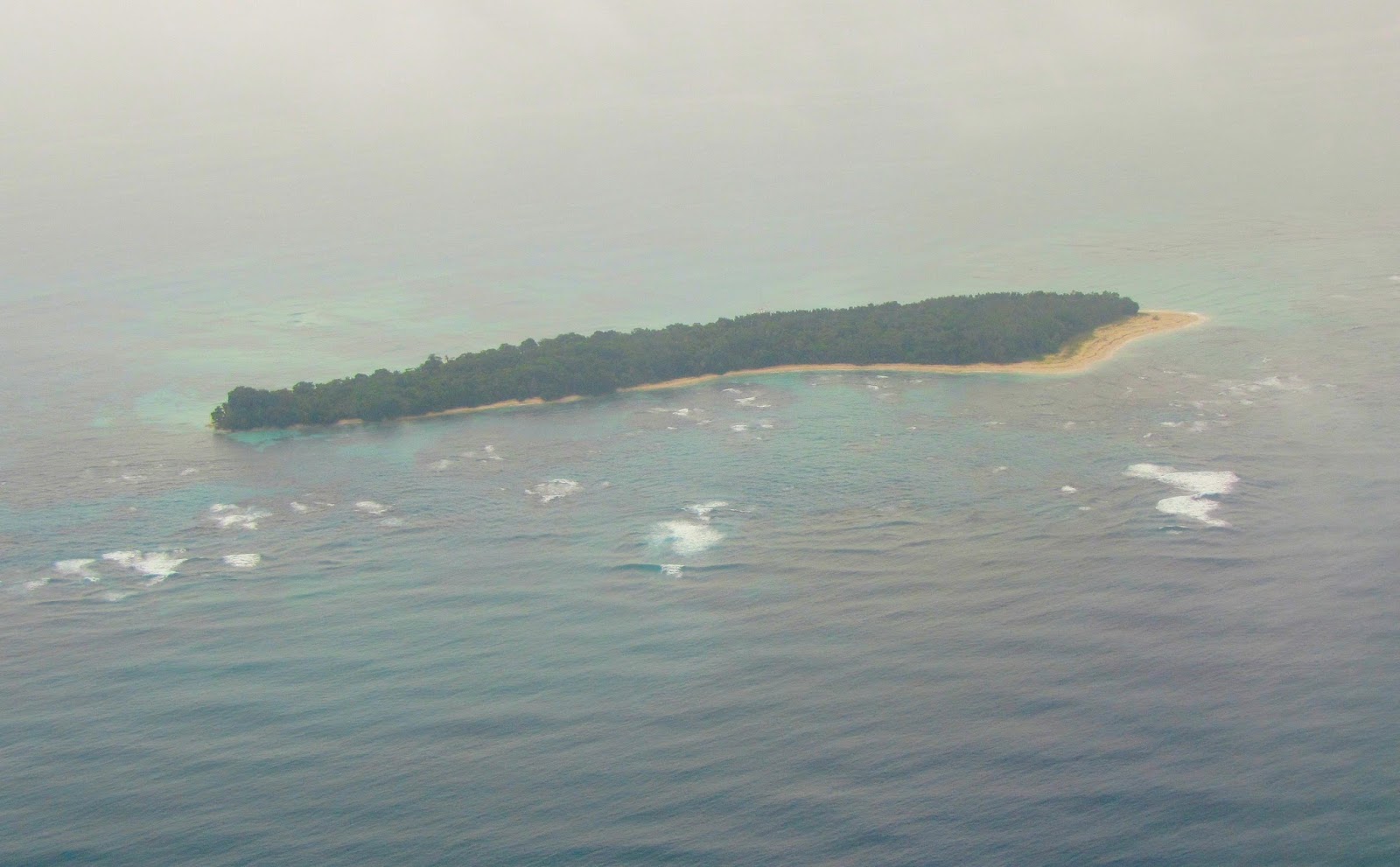

One of the Zapatilla Cays is the site of a long-term project on the biology and
conservation of hawksbill turtles.  The view from the plane is nicer on sunny days.


A very quiet early morning on a wet day.  You can hardly 
imagine this sleepy main street full of tourists.
The town of Bocas del Toro is a different world from Panama City.  Sleepy and, at the same time, a touristic hotspot, full of restaurants and bars.  I bypass what’s on offer and head in to work.


Arriving at the station before 8, I have a few minutes before the staff arrive and the researchers appear, ready for another day in the field or lab.

The BRS station building.  Peaceful in the early morning.
It's going to be a busy day.  Welcoming the students and instructors of a visiting course.  Meeting with my advisees, and discussing budget and administrative issues with the station staff.  If I’m lucky I’ll have time for a swim.  If... I finish before dark.... and it doesn't rain too hard....

Friday, April 26, 2013

Gabon – Just Like Panama, But With Hippos


In March I visited Gabon, a small tropical country with a rich and diverse mix of cultures.  
A paradise for biologists: known for vast expanses of tropical forests, dense mangrove swamps, rich bird life and annual visits from breeding humpback whales and nesting turtles.  Sounds just like Panama!  

Panama and Gabon do have a lot in common.

Smithsonian researchers are working to understand tropical biodiversity in both countries:
The SI lab in Gamba, Gabon.  It's not that different 
from the old lab in Gamboa, Panama
Both countries have huge expanses of mangroves:
Black mangrove forest near Gamba, Gabon


Mangroves in Panama don't have hippos lurking offshore
and hippo trails cutting through the mangroves stems.


Red mangroves near Libreville, Gabon


Upwelling and mangrove swamps support productive fisheries:

A trawler working near Libreville, Gabon.  Trawlers in Panama
look similar but are  usually slightly smaller and made of wood.
As well as some large differences….
 
A forest elephant.  Yes it was big and close.

Elephants!   Not something you need to worry about in Panama.

Why was a Marine Biologist watching elephants and hippos? -  Well here’s the backstory.

Permanent Forest Plots - SIGEO.  Just like Panama, Gabon is the site of a Smithsonian Global Earth Observatory (SIGEO).  These sites are part of a global network of permanent forest plots in which every tree is identified, tagged and followed through time, using standard methods.  Through this network an international team of forest scientists seek to answer questions about how tropical forest diversity is generated and maintained; how the world’s forests act to store Carbon; how human activities impact forest ecosystems.   Gabon’s site in Rabi is one of the newest plots and Panama’s site on Barro Colorado Island is the original plot.  


With a "big tree" in Gabon 2013
With a "big tree" in Panama 2007


Unfortunately, as marine biologists we didn’t have the chance to visit Rabi, but we did get to see some very big trees in the forest around the Smithsonian base in Gamba.  Just like home.

Permanent Marine Observatories – MarineGEO
The Smithsonian Institution is launching a network of sites dedicated to understanding the marine realm.  Based on the SIGEO concept, this global network will apply standardized methodologies to questions about the biodiversity of marine ecosystems (reefs, mangroves, saltmarshes, etc.) and the health and resilience of these ecosystems.  The network will expand rapidly from the initial Tennenbaum Marine Observatories run by the Smithsonian Institution in Maryland, Florida, Belize and Panama.  

My colleague, Pat Megonigal, and I visited Gabon to determine how we could extend the existing in-country collaborations to support an expansion of MarineGEO network to Africa.  

Peat and blue carbon:
Pat checking out the sediment in the mangroves.  Some of the
mangroves were associated with extensive peat deposits. 
The weirdest thing was.... there were no mosquitos!
Look rhodoliths:
These pink rocks are actually living red algae.  We found 
beds of rhodoliths  in the intertidal of Gabon,  similar to the 
extensive subtidal beds in the Bay of Panama.
A nerite snail laying eggs:

This nerite snails has laid white egg capsules just outside this
small pool just north of Libreville.  In Panama nerites 
deposit their eggs in the pools.
Beaches and sunsets:
Beach near Cap Esterias, Gabon

Sunset over Cap Esterias, Gabon 
Beach flat at Cap Esterias, Gabon

Sunset over Libreville, Gabon

Check out this Gabon blog by David Korte to learn more about natural history, Smithsonian research, and life in Gamba.