Tuesday, October 6, 2020

The identity of this unusual sea creature was a mystery to biologists for 30 years.

The key to figuring it out was to think globally, not locally.

Mystery has surrounded these tiny animals since they were first discovered in the Gulf Stream.  Easily identified as sea star larvae (i.e., babies) they are some of the most abundant animals in certain plankton samples. Not only are samples “crawling” with them, but they show evidence of cloning themselves, something that was previously not known to occur in sea star larvae.  Using DNA sequences scientists have searched for 30 years for a match between these distinctive larvae and adult sea stars from the Gulf of Mexico and the Caribbean.


We collected some of the mystery larvae as part of project to describe and identify the larvae living in Panamanian waters. Like the prince with Cinderella’s slipper, we initially could not find a match to our DNA sequences either.  Using the Barcode of Life Database, we discovered a match to an unpublished sequence from the Indo-Pacific. No information other than the name of the scientist who generated the sequence was public, Gustav Paulay. Luckily (in this case anyway), the community of biologists working on marine invertebrates is small and I knew Gustav. After comparing the sequences, we agreed that the sequences from the Caribbean larvae match the sequences of a rarely seen sea star from the Indo-West Pacific, Valvaster striatus


This sea star appears to range across almost all of the Pacific, but it lives deeply hidden inside coral reefs, making them difficult to find without literally taking the reef apart.  


Adults have never been reported in the Caribbean, but they must presumably be lurking here, out of sight, shedding eggs and sperm into the water column to generate these famous larvae…. Or… maybe the larvae are cloning themselves, maintaining dense populations without the need for adults.


Only time (and more research) will tell.


Read our original publication at:  https://www.journals.uchicago.edu/doi/10.1086/710796


Collin, R., D. E. Venera-PontónG. Paulay, and M. J. Boyle.  2020.  World Travelers: DNA Barcoding Unmasks the Origin of Cloning Asteroid Larvae from the Caribbean.  Biological Bulletin.  doi/10.1086/710796


Sunday, November 2, 2014

Do Slipper Snails Really Brood in the Mantle Cavity

Slipper snails brood their offspring.  They produce eggs enclosed in transparent capsules and they keep these covered by the shell.  The scientific literature is full of statements that they "brood in the mantle cavity".  This is not accurate.

What is the mantle cavity?
The mantle is characteristic of molluscs and is basically a skirt of tissue formed by the dorsal body wall  that covers the visceral mass.  In squid it is the part that is used as squid rings.  In clams and snails it is the tissue that underlies the shell.
Head-on view of a Crepidula

The mantle cavity is defined as the space enclosed by the mantle and  includes the gills, anus, osphradium and gonopores.  In slipper snails this space is large, to contain the extensive gills needed for filter feeding.  It extends from the front margin of the shell, over the head, and gradually tapers all the way to the posterior end.

Slipper snails do not brood their egg capsules in this space.

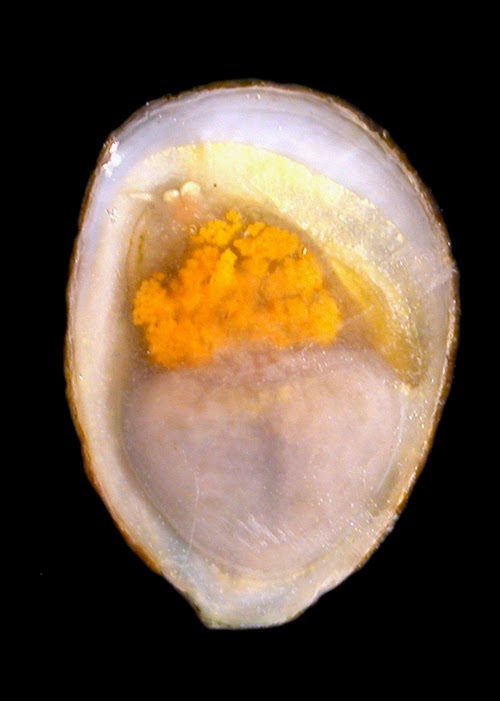
Crepidula atrasolea brooding.  The eggs are orange and
can be seen through the plastic the snail has attached to


Where do slipper snails keep their eggs?
In the CollinLab we keep slipper snails in plastic cups.  In this way we can see when they produce eggs and we can collect the embryos or larvae at the age or stage we need.  Looking a the snails in this way it is very clear that the egg capsules are deposited under the snail, not above the head in the mantle cavity, but below the head.  The mother attaches the stalks of the capsules to the substrate beneath her neck.  As far as we know there is not formal anatomical name for this space.  In publications we say that slipper snails brood the egg capsules "between the substrate, the neck and the propodium".

Head-on view showing the location of the eggs relative to the mantle cavity

Lateral view showing the eggs relative to the mantle cavity


Tuesday, February 11, 2014

Why snails sometimes wear nail polish and corals sometimes wear tampons

The second floor of the Naos Laboratories is packed to the ceiling with high-tech DNA sequencing equipment: precision incubators, heatblocks, PCR machines for replicating DNA molecules, robots for processing samples and DNA sequencing machines.

It’s a different story up on the third floor. You’d be surprised at what things ecologists bring in from home to use in the lab.  Here are a few of the items we use in the CollinLab:

Nail polish is great for marking individual snails.  We want to follow snails in the intertidal to see if they return every day to the same pool or crevice.  Now that you can get so many colors it's perfect to just dab a bit of polish on each snail. 

20 years ago it was all shades of red and pink, but now the snails can really shine. 
…. and yes, certain snails look better in certain colors.

A yogurt maker has been used in the lab to test the tolerance of Nerita egg capsules to high temperatures.  Aquarium heaters have a built-in shut-off before they reach temperatures experienced in tropical tide pools. The yogurt maker hits the exact temperature.


Custard dishes.  We buy these by the case to use for larval rearing experiments.  They fit perfectly under the microscope.


It's not just the CollinLab that gets creative.  In fact, we are rather tame in our choices compared to some famous marine biology researchers.  My favorite examples include:

In a flamboyant landmark study Mimi Koehl and Tom Powell threw pounds of glitter, poppy seeds and snapdragon seeds off the rocks of the Washington coast.  They wanted to understand how waves disperse small particles away from the intertidal. The glitter and seeds were used to model different kinds of marine invertebrate eggs (some eggs are buoyant and some sink).  So they released thousands of these "artificial" eggs at one time and used fluorescein to label the sea water.  A team of students and helpers scooped up samples of water along the coast to track the movement of the different particles to see if they all traveled in the same way with the water. 


In a another important but quirky study, researchers working at the Bocas del Toro Research Station tied tampons to corals.  They wanted to understand the causative agents of coral disease.  Davey Kline and Steve Vollmer extracted different microbes from infected areas of coral tissues.  To find out which of these cause the disease, which are benign, and which are secondary infections that do not transmit the disease, they needed to expose corals to the different isolated microbes.  They searched the small town of Bocas del Toro for materials that could be used to absorb the different solutions and tied to the corals to expose an area of health tissue to the potential pathogens.  Tampons turned out to be perfect!  The experiment was a success and was published in Nature-Scientific Reports.


Let us know if you have used art, kitchen, or personal supplies for unusual scientific purposes.