Showing posts with label Panama. Show all posts

Monday, December 24, 2012

Summer's here!


 Last week it was humid, rainy, and cool -
well cool for Panama.

Just like that!  It's summer.    

And this week it is bright, blue and breezy.
It’s always confusing here when we talk about summer.  The gringos usually mean June-August, the summer holidays for universities in the north; the summer field season for hard-working graduate students; the busy season for the field stations. 

But here, for Panamanians, summer starts in the weeks before or after Christmas.  It’s not a date you can find in the calendar. There’s no gradual spring warming.  It switches almost from one day to the next. 

What happens is this…..the Inter-Tropical Convergence Zone (ITCZ) is a thin strip of low pressure between two areas of high pressure, one in the subtropical part of the northern hemisphere and the other in the southern hemispheres.  You can see the ITCZ from satellite photos.  It’s the band of clouds and storms swirling around the equator.  During the dry season the northern hemisphere areas of high pressure push the ITCZ south keeping it south of Panama and we get blue skies and breezy dry days.  The rest of the year it is closer to us and keeps things wet and cloudy.
Red arrow points to us in Panama, orange arrows show the
line of clouds and rain.  Photo from NASA.


Biologically this has large effects.   In the dry season it doesn’t rain for weeks or even months.  Trees lose their leaves. Dry grassy areas burn.  Residents spend time watering their lawns. 

For us marine biologists things are different. The strong winds cause upwelling of cool water, so it’s cold for marine life in Panama.  Plankton blooms in the Bay of Panama. Tuna and dolphins arrive to take advantage of the little fish that thrive in upwelling.  And the animals we work on in the intertidal have to cope with wild fluctuations between the cold water and the scorching sun as the tide goes in and out.

Click for more information about the ITCZ in the news


Thursday, August 23, 2012

Surrounded by History (Part 2)


During my time in Panamá, I was lucky enough to be able to help a few amazing biologists with their fieldwork. Some of my greatest memories in biology come from these adventures in the field or simply lending a hand in lab. One of my favorite memories is exploring Fort Grant, which is an abandoned U.S. military post that was used to defend the Panama Canal.

In our post Surrounded by History (Part1) we described the history of our laboratory building which historically was an old Panama Canal train maintenance station that has been long since remodeled as a three-story research facility. Even though it was remodeled, the building still shows clues to its original purpose. The three islands on the Amador Causeway, Naos, Perico, and Flamenco, also have a hidden history. But if you know where to look you can find the clues to its interesting past.

These islands are literally filled with history...


The Panama Canal was completed in 1914 just as
World War I began. But even before then, security around the canal was a major concern. The three islands are located at a perfect strategic point, even pirates used to hide out around them, so naturally they were set up to defend the Pacific side of the canal. The islands became part of Fort Amador and each was fortified with an extensive bunker system and equipped with various guns and missiles throughout the years.


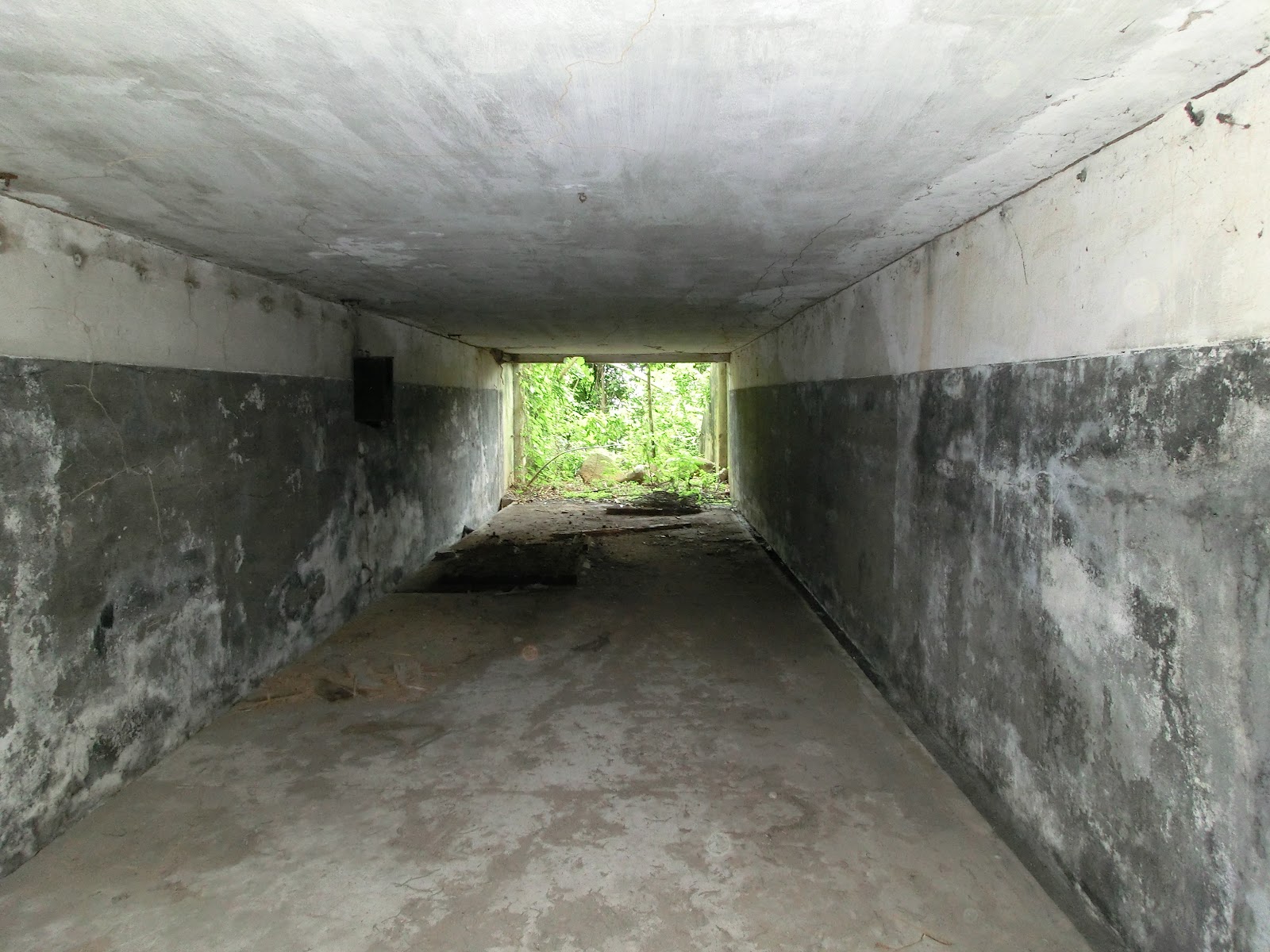
It just so happens that the entrances to a few of the bunkers are hidden behind our laboratory building. I was lucky enough to see inside them! The first time I went through the bunkers I was helping John Delton Hanson, a visiting mammalogist, set traps to catch mice and rats on peak of Naos Island. because the island is so steep and the vegetation is so dense, the best way to climb the Island was to take the dark bunker tunnel.

When you enter the bunker you are faced with a daunting straight staircase. The first things you notice   is the incredible length of the straight stairs, the absolute darkness surrounding, and just how tired your legs get. The stairs seem to go up forever. But that isn't the worst part. Once you're about 3/4 of the way up, you'll notice that you are not alone. The bunker is now home to lots and lots of bats! But they didn't bother us very much. John even tried to catch one!


At the top of the long dark stairway, there is a long dark hallway. The hallway and all the rooms that branch off of it are mostly empty now. The lights, pluming, wiring, just about everything is long gone. Everything, that is, except for a broken blue toilet.


But there was also light at the end of the tunnel! An opening to the top of the hill! Outside I was amazed to find a large cement clearing. I had no idea this existed. From the street and from the lab all of this is completely hidden. I later found out that what we saw was originally the platform for a 14-inch rifle on a disappearing carriage. Isla Naos was fortified with three Batteries: Buell, Burnside and Parke. Batteries Buell and Burnside each had two 14-inch rifles with a range of 18,400 yards (10 miles). Parke had two 6-inch rifles with a range of 6,000 yards.

A similar structure is installed on the third island, Isla Flamenco.
Photo by Life Magazine, 1941


Fort Grant 2012
Fort Grant 2012


The costal defenses were in place until the advent of airpower during World War II. Hawk missiles later replaced these guns.

At the end of the day, we had caught a few mice, but for me, discovering the hidden history inside and atop Naos Island was really a special adventure.


Additional Pictures:


Post by Matt Starr

www.mjstarr.net

For more information try these sites!

http://www.thepanamanews.com/pn/v_11/issue_09/community_02.html
http://groups.yahoo.com/group/PanamaVets/message/24739?var=1
https://www.facebook.com/note.php?note_id=124893138037
http://www.zonianlady.com/fortamador/fortamador.html
http://home.comcast.net/~bcole3/517tharty/BatteryC.htm
http://gozonian.org/2006data/2006hist/FortAmadorHistory.htm

Saturday, August 18, 2012

Introducing Slipper Snails


A lot of the research in the Collin Lab focuses on slipper snails (sometimes called slipper limpets or slipper shells).  I like to refer to them as slipper snails because they are more than just a shell; they are really cool and complicated animals. 

The Latin name for the genus of slipper snails is Crepidula.

Slipper snails and their relatives all belong to a single family, the Calyptraeidae.  Future posts will explain the questions we are trying to answer, the methods we employ, and some of the things we have discovered. But for now, here are a few quick facts as an introduction to my favorite snails.

New species are being discovered all the time. At the moment, there are about 200 species of calyptraeids.  That is, there are 200 species that have been officially described and named, and which biologists agree represent distinct species.  But nobody really knows how many species have yet to be discovered.

I described and named Crepidula ustulatulina in 2002.

Slipper snails change sex.  Small young animals first develop as males. As they grow they gradually change to become female.  Once female they cannot change back.  This kind of sex change - from male to female - is known as protandry.  Sex change from female to male, which is seen in a number of fishes is known as protogyny.

Slipper snails do not move around much. They don’t have to because they are filter feeders –in other words they filter particles out of the water for food – so they don’t have to search for food.   They attach themselves to the substrate and hunker down in the face of adversity. 

Crepidula fornicata
They often just look like bumps on a rock.

The most important aspect of calyptraeid biology, from the point of view of our research, is that slipper snails display an amazing diversity in how they develop from eggs to adults.  Some species have swimming larvae, some species have large eggs that develop directly into juveniles that look like small adults, in some species the embryos actually eat their siblings as they grow, and in other species the kind of development can change during the life of the mother.