Friday, September 14, 2012

Crepidula fornicata: descriptive name or tasteless joke?

The name Crepidula fornicata always elicits giggles.  Understandably.  The last place anyone expects to see rude jokes is in an official Latin name.

The snails themselves are the most abundant and widely recognized slipper snails.  They are originally from the east coast of North America.  But they were introduced into England in the late 19th century and are now also widely distributed in Europe.  Like all calyptraeids they change sex from male to female.  One unusual thing about Crepidula fornicata is that the animals often stack up one on top of the other. The males, which are smaller, sit on the backs of the females (can you see where this is going?). 


Clusters of Crepidula fornicata attached to a clam shell.
So how does this relate to the name Crepidula fornicata? 
The genus name, Crepidula, is straightforward Latin and refers to a small slipper or sandal.  This name was first applied to slipper shells in 1822 by the great evolutionary biologist and natural historian Jean-Baptiste Lamarck, and has been used every since.   

The species name, fornicata (giggle), which distinguishes this species from other species of Crepidula is even older, and the meaning is not so clear.  Following the system designed by Carl Linnaeus - the originator of the naming system we use today – the species name is usually descriptive.  This helps biologists remember the names of the species:  Crepidula plana is flat; Crucibulum spinosum is spiny; and so forth.

So the serious and rather dry explanation for the name fornicata is that when Linnaeus himself coined the name in 1758 he was referring to the shape of the shell.  Fornicata from the root fornicatus means vaulted or arched. 


Crepidula fornicata "fornicating"
BUT…. Could the name also be a lascivious reference to the animals’ sex lives?
A rude joke would be in character for Linnaeus.  Surprisingly, going against all of our stereotypes of dry old scientists, there are quite a few records of Carl’s sense of humor.  He famously named the blue whale Balaenoptera musculus, which means both “muscular” but also “little mouse".  He pointedly named a useless and obscure weed after one of his critics.  His salty language and focus on the sexual organs of flowers for identification (features that are still useful today), was considered at the time as "too smutty for British ears".  He also named a number of clams and mussels for their resemblance to female genitalia.  Smutty indeed.  And not something most of us would notice when facing a plate of clams with garlic and olive oil.


The original description gives us no clues:  “Oval shell, intact posterior, obliquely curved, concave rear lip.  Habitat to Elba Island.  Differs from the preceding base lateral, white concave shelf.”

I don’t know if the name fornicata reflected Linnaeus’ knowledge of the sex lives of these snails.  It seems unlikely.  At the time samples reaching Europe from the New World were almost exclusively shells.  Sex change in Crepidula was not to be discovered for another 150 years, but perhaps reports of aggregations of small and large animals reached Linnaeus.  Maybe that was all the suggestion he needed.  With his naughty interpretation of so much biology and his propensity to pun, it is quite possible that the name is a clever wordplay on fornicatus meaning arched, and fornicor meaning to fornicate or to prostitute.


Saturday, September 1, 2012

Parking Lot Ecotourism

Look what we saw from my office window today!


It seems that the two-toed sloths like to forage in that particular tree. Someone told me that sloths especially like the white flowers on these trees, but from here I can’t see any flowers.   I most often see the sloths around 4pm, just after the students leave for the van that takes them back to the city.  Sloths aren’t social but there are usually two together, and I wonder why; are they mother and baby? They look too close in size for that.  Friends? Competitors, each one trying to get to the best leaves first?


For marine biologists it is fantastic and a little bit unusual to be so close to forest animals. Because the island is so small, wildlife from the seasonal dry forest on Naos and Culebra often venture down into the parking lot. And they come close to the office windows. So we can see some nice animals from the comfort of our office chairs. It makes a nice break.

We often see green iguanas sunning themselves on the roofs. It’s a treat to see a large male climbing up the papaya trees around the lab. They feast on the fruit as they ripen, leaving none for us.


Green iguana and papayas

In the early evening it’s common to see armadillos at the edge of the shrubbery. Bats come later to feed on the fruits of the sea almond trees planted around the parking lot. At night they are just a flurry of wings in the dark, but in the morning we find the chewed fruits lying under the trees.

Nine-banded Armadillo


We are also surrounded by numerous smaller animals: lizards, song birds, myriad insects, spiders, scorpions….  Even though we are biologists, few of us stop to observe these less obvious animals.  We keep our heads down as we hurry from the parking lot to our offices in the morning or head home at the end of the day.  But who doesn’t stop to watch a sloth?


Thursday, August 23, 2012

Surrounded by History (Part 2)


During my time in Panamá, I was lucky enough to be able to help a few amazing biologists with their fieldwork. Some of my greatest memories in biology come from these adventures in the field or simply lending a hand in lab. One of my favorite memories is exploring Fort Grant, which is an abandoned U.S. military post that was used to defend the Panama Canal.

In our post Surrounded by History (Part1) we described the history of our laboratory building which historically was an old Panama Canal train maintenance station that has been long since remodeled as a three-story research facility. Even though it was remodeled, the building still shows clues to its original purpose. The three islands on the Amador Causeway, Naos, Perico, and Flamenco, also have a hidden history. But if you know where to look you can find the clues to its interesting past.

These islands are literally filled with history...


The Panama Canal was completed in 1914 just as
World War I began. But even before then, security around the canal was a major concern. The three islands are located at a perfect strategic point, even pirates used to hide out around them, so naturally they were set up to defend the Pacific side of the canal. The islands became part of Fort Amador and each was fortified with an extensive bunker system and equipped with various guns and missiles throughout the years.


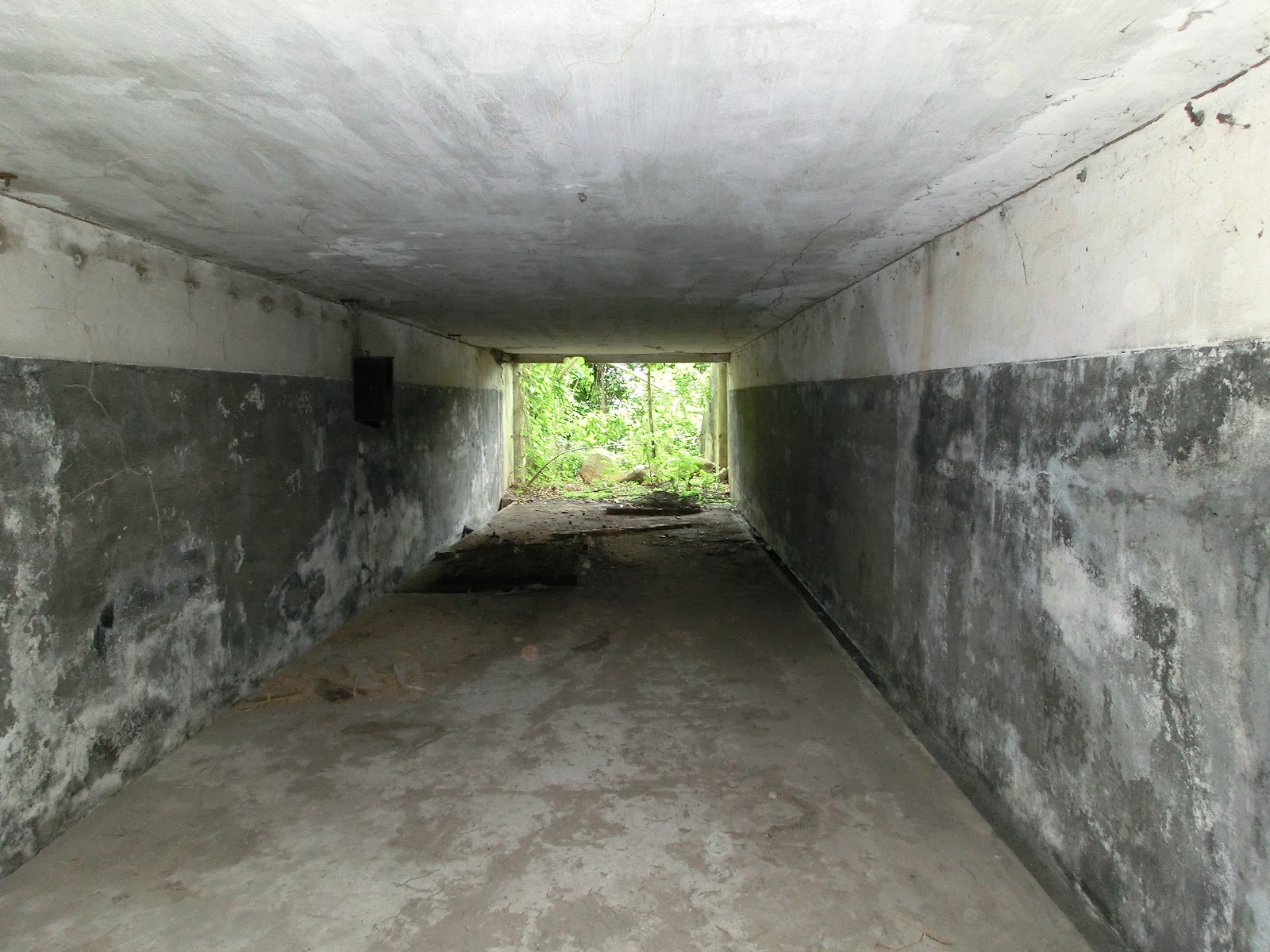
It just so happens that the entrances to a few of the bunkers are hidden behind our laboratory building. I was lucky enough to see inside them! The first time I went through the bunkers I was helping John Delton Hanson, a visiting mammalogist, set traps to catch mice and rats on peak of Naos Island. because the island is so steep and the vegetation is so dense, the best way to climb the Island was to take the dark bunker tunnel.

When you enter the bunker you are faced with a daunting straight staircase. The first things you notice   is the incredible length of the straight stairs, the absolute darkness surrounding, and just how tired your legs get. The stairs seem to go up forever. But that isn't the worst part. Once you're about 3/4 of the way up, you'll notice that you are not alone. The bunker is now home to lots and lots of bats! But they didn't bother us very much. John even tried to catch one!


At the top of the long dark stairway, there is a long dark hallway. The hallway and all the rooms that branch off of it are mostly empty now. The lights, pluming, wiring, just about everything is long gone. Everything, that is, except for a broken blue toilet.


But there was also light at the end of the tunnel! An opening to the top of the hill! Outside I was amazed to find a large cement clearing. I had no idea this existed. From the street and from the lab all of this is completely hidden. I later found out that what we saw was originally the platform for a 14-inch rifle on a disappearing carriage. Isla Naos was fortified with three Batteries: Buell, Burnside and Parke. Batteries Buell and Burnside each had two 14-inch rifles with a range of 18,400 yards (10 miles). Parke had two 6-inch rifles with a range of 6,000 yards.

A similar structure is installed on the third island, Isla Flamenco.
Photo by Life Magazine, 1941


Fort Grant 2012
Fort Grant 2012


The costal defenses were in place until the advent of airpower during World War II. Hawk missiles later replaced these guns.

At the end of the day, we had caught a few mice, but for me, discovering the hidden history inside and atop Naos Island was really a special adventure.


Additional Pictures:


Post by Matt Starr

www.mjstarr.net

For more information try these sites!

http://www.thepanamanews.com/pn/v_11/issue_09/community_02.html
http://groups.yahoo.com/group/PanamaVets/message/24739?var=1
https://www.facebook.com/note.php?note_id=124893138037
http://www.zonianlady.com/fortamador/fortamador.html
http://home.comcast.net/~bcole3/517tharty/BatteryC.htm
http://gozonian.org/2006data/2006hist/FortAmadorHistory.htm